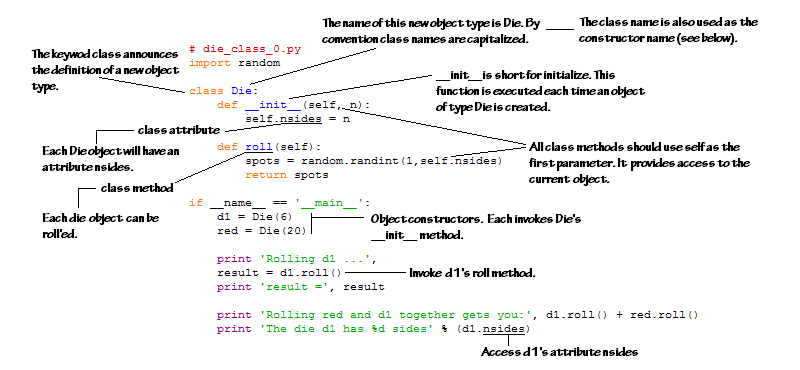
A small example: A dice class
Before considering an extended example let's consider a small one to see
what the syntactical elements are that support OOP in Python. In Python as in
most OOP languages (including C++ and Java—but not Javascript)
the key OOP construct is the class. A class specifies the characteristics of
an object type and provides a rubber stamp or template for creating objects
of a particular type. Consider for example a die (as in one dice, not death!).
A die is quite a simple object. It has a single attribute, its number of
sides, and just one method, roll, i.e. the only message you can
really send a die is to roll itself and report the result. Like I said it's a
simple object. Here is a complete importable module that defines
a Die class and some code to test it (minimally). First the code
alone (I have left out the docstrings to avoid obscuring the functional code):
# die_class_0.py
import random

class Die:
    def __init__(self, n):
        self.nsides = n

    def roll(self):
        spots = random.randint(1,self.nsides)
        return spots

if __name__ == '__main__':
    d1 = Die(6)
    red = Die(20)

    print 'Rolling d1 ...',
    result = d1.roll()
    print 'result =', result

    print 'Rolling red and d1 together gets you:', d1.roll() + red.roll()
    print 'The die d1 has %d sides' % (d1.nsides)
and then the code with (hopefully helpful) annotations,