Recursion offers an alternative mechanism for repetition.
Alternative to explicit looping constructs like
for and while.
The key to desigining a recursive function is to stop thinking about writing a function that does the whole job, and to start thinking about a function that just,
knows the next specific step to take to move toward the answer, and
can tell when there's no point in trying.
b. above is the stopping condition and without one you may well create an infinite loop. See e.g. the first example in recursion.py.
Each recursive call starts a new execution of the function code.
The state information of the current call (i.e. the values of the local variables) is pushed onto a stack (like appending to the end of a list).
When the called instance terminates, the caller is restarted and its local state is popped off the stack to remember "where it was".
If you have started ten instances of a function, then there are 9 packages of state piled on the stack waiting to be popped off as paused invocations are restarted.
The recursion call stack is large but not infinite: typically a thousand or so entries. You can make it larger (or smaller), but shouldn't generally want to.
Recursion can be direct in which a function calls itself, or indirect in which one function, say A, calls another, B, which then calls A, which calls B, which calls A,...
We are seeing recursion now because it simplifies the implementation of some algorithms we are about to encounter, i.e. quicksort and heapsort.
Recursion is most helpful when dealing with recursive data structures. For example in a binary tree each part of the tree is itself a binary tree.
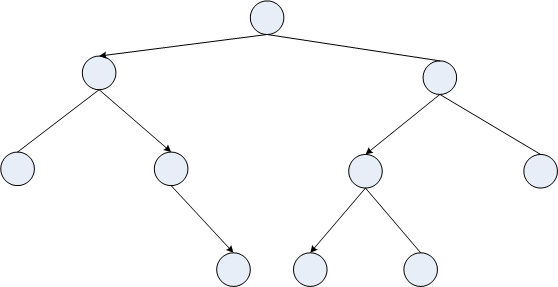 .