Start by watching the portion of Sorting Out Sorting that covers Heapsort again. At first Heapsort may look like some manic game of musical chairs with values dancing around a "tree". But if you watch carefully (or perhaps enough times!), a general pattern should become apparent: create a heap, move a value, reheap.
First we convert the whole tree to a heap. Then we move the top item in the tree to the current last position in the list. Now moving that last value into the root position of the tree will usually unheapify the tree, so we reheapify it (but not including that last item). We repeat this as many times as there are items in the tree.
Written out in pseudocode format instead of English we get something like this,
heapify the tree
As many times as there are elements in the list:
    swap the root element with the last element
    reheapify the tree (except for last item)
There are some clarifications needed:
The first is that last changes, it reduces by one on each iteration. It starts out as the last position in the list and then moves forward one position on each iteration (in the video this corresponds to moving across the tree from right to left and then up a level as necessary).
The second is that heapify and reheapify are not identical processes. If you watch the video again you will see that the initial heapifying is bottom up. It starts with the bottommost subtrees of 3 elements and then works its way upward. Reheapifying can start at the top and then work its way down one path in the tree, because the root-last swap that was done can be fixed by rejigging just one path from the root to a leaf.
Taking these changes into account produces a refined version:
heapify the tree
set last to len(lst) - 1
while last > 0:
    swap the root with last
    reheap the tree stopping before last
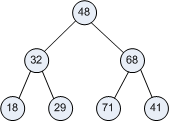
So what exactly do we do when we reheap starting at a particular location? We check that value against its children and make sure it is larger than them. If it is, we are done. If it isn't we swap it with the largest of its children and then call reheap on the subtree that starts at that child (so it is a recursive procedure), e.g. if we begin with this,
we heap the top subtree to get this,
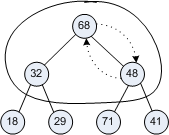
and then call reheap on the lower right subtree,
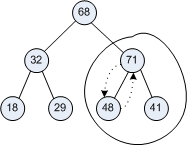
to get this final subtree,
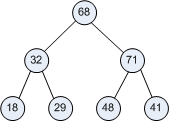
Reheaping then works like this,
compare root (of subtree) with both children
if root is larger than both children stop
elif the left child is largest
    swap root and left child
    call reheap on left child subtree
elif the right child is largest
    swap root and right child
    call reheap on right child subtree
or translated into something Pythonish after rearranging the tests so as not to bother starting with a do nothing branch,
def reheap(lst, node):
    lc = left_child(node)
    rc = right_child(node)
    if lst[lc] > lst[node] and lst[lc] >lst[rc]:
        (lst[lc], lst[node]) = (lst[node], lst[lc])
        reheap(lst, lc)
    elif lst[rc] > lst[node]:
        (lst[rc], lst[node]) = (lst[node], lst[rc])
        reheap(lst, rc)
Running this reveals that it doesn't know when to stop reheaping and falls off the bottom of the tree heading downward (because we forgot to provide a stopping condition for the recursive calls). We fix this by adding a stopping point to get,
# reheap.py

def left_child( node ):
    return 2*node + 1
def right_child( node ):
    return 2*node + 2

def reheap(lst, node, stop):
    lc = left_child(node)
    rc = right_child(node)
    if lc >= stop:
        return
    if lst[lc] > lst[node] and lst[lc] >lst[rc]:
        (lst[lc], lst[node]) = (lst[node], lst[lc])
        reheap(lst, lc, stop)
    elif lst[rc] > lst[node]:
        (lst[rc], lst[node]) = (lst[node], lst[rc])
        reheap(lst, rc, stop)

lst = [48, 32, 68, 18, 29, 71, 41]
print 'Before:', lst
reheap(lst, 0, len(lst)-1)
print 'After:', lst
This works on a full tree, but it does assume that nodes always have both children which will not always be the case.
With reheap in place we can further refine our earlier pseudocode,
heapify the tree
for last in range(len(lst)-1, -1, -1):
    (lst[0], lst[last]) = (lst[last], lst[0])
    reheap(lst, 0, last)
Which just leaves the puzzle of what "heapify the tree" means. In retrospect, with the experience we have gained writing reheap, it's not hard to see that heapify just consists of calling reheap on all subtrees of the list from the bottom up,
# heapify.py

def parent(node):
    return (node-1)/2

def heapify(lst):
    for node in range(parent(len(lst)-1), -1, -1):
        reheap(lst, node, len(lst)-1)

lst = [48, 32, 68, 18, 29, 71, 41]
print 'Before:', lst
heapify(lst)
print 'After:', lst
Now we just need to combine these to get a working Python heapsort:
# heapsort.py

def left_child( node ):
    return 2*node + 1

def right_child( node ):
    return 2*node + 2

def parent(node):
    return (node-1)/2


def reheap(lst, node, stop):
    lc = left_child(node)
    rc = right_child(node)
    if lc >= stop:
        return
    if lst[lc] > lst[node] and lst[lc] >lst[rc]:
        (lst[lc], lst[node]) = (lst[node], lst[lc])
        reheap(lst, lc, stop)
    elif lst[rc] > lst[node]:
        (lst[rc], lst[node]) = (lst[node], lst[rc])
        reheap(lst, rc, stop)

def heapify(lst):
    for node in range(parent(len(lst)-1), -1, -1):
        reheap(lst, node, len(lst)-1)

def heapsort(lst):
    heapify(lst)
    print 'Heaped:', lst
    for last in range(len(lst)-1, -1, -1):
        (lst[0], lst[last]) = (lst[last], lst[0])
        reheap(lst, 0, last-1)
        print lst

lst = [48, 32, 68, 18, 29, 71, 41]
print 'Before:', lst
heapsort(lst)
print 'After:', lst
Which works on many but not all lists. Problem 2 on the assignment is to tweak it so it works on all lists.