Let's think a bit about how the process of "trying all combinations" of actions might play out. We'll start with the first problem,
"You are at the side of a river. You have a three-litre pitcher and a seven-litre pitcher. The pitchers do not have markings to allow measuring smaller quantities. You need four liters of water. How can you measure four liters?"
Remember our possible actions are: fill, pour and empty.
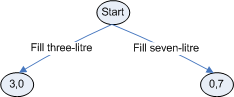
Since the pitchers are empty we can't pour from or empty them, but we can fill them, so we have two possible actions: fill the three-litre pitcher, or fill the seven-litre pitcher. Each of those results in a new state of the pitchers:
You can see I've introduced some notation here. The pairs of numbers in the ovals represent the number of litres of water in each pitcher, listed in order of pitcher size, smaller pitcher first. Now neither of those ovals features a 4, the amount we are aiming for, so we are not done. Let's consider our next possible actions. From the state 3,0 we could; empty the three-litre pitcher, pour from the three-litre pitcher into the seven-litre pitcher, or fill the seven-litre pitcher.
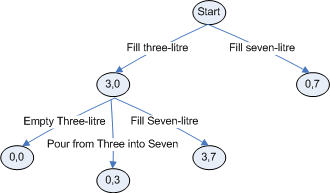
And now you can see what we've got! We're building a tree of possibilities. From each state, taking each of the possible actions extends the tree downwards into new states. We'll be done when one of those states contains a 4 (or thinking back to our earlier observation of multi-pitcher solutions when a subset of our states adds to 4). There's no 4 in any of the states we've reached so far so we're not done. But now the question arises, how shall we grow our tree? Should we continue down the left-hand side and expand on the 0,0 state, or move over to the right branch and continue from the 0,7 state? The first strategy is called a depth-first search while the second is a breadth-first search.
Depth-first means you grow as deep as it is possible to grow along one route and then if it dead-ends and is not a solution back up and try growing another path. We've used that approach before. For example our maze-carving algorithm grew each path until it couldn't grow any more, and then it backed up the list of visited cells and grew another path. The problem with depth-first explorations in some problems is that the path might be infinite, i.e. you might be able to grow it forever without reaching the solution. That could happen here where we could become stuck in a loop of filling then emptying then filling then emptying a pitcher (we know that's not going anywhere, but the algorithm might not). In most game-playing situations (like thi one) breadth-first is the way to go.
In this case that means our next step is to grow down from the 0,7 state:
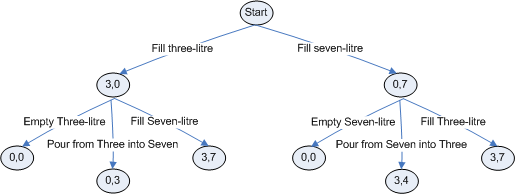
and we reach the solution in the state 3,4!