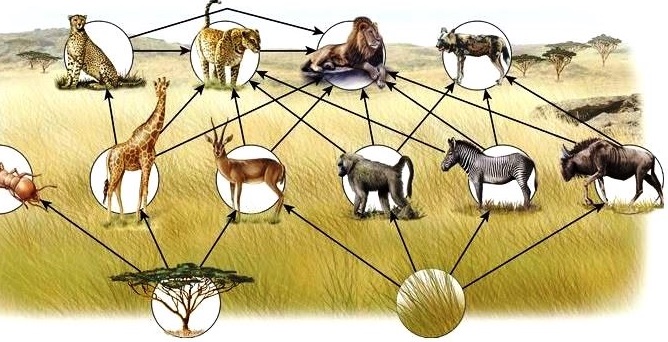
Ecology and ecosystems are all about connections and the interactions between things, but our
models have mostly focussed on the optimal behaviour exhibited by individuals (whether
corporate or animal). How do we describe, model and analyse systems of things? The key is to
have a way of representing and quantifying the structures of a system: its physical
structure sometimes, but also the structure of the interactions of its components,
whether that is the flow of nutrients, or energy, or $, or prestige, or... Graph theory provides us with the
tools we need to do this, and is the final topic of the course. 😅
These are not the function graphs you are used to, but circle and arrow diagrams like the
image above with the animal pictures removed. They have a surprising number of uses.
Monday An introduction to vertex-and-edge graphs, and two algorithms: Minimal Spanning
Tree (MST) and Shortest Route.
Wednesday In addition to vertex-and-edge diagrams, graphs can be represented in
Matrices! 🤯 We'll see how to do that, and how to carry out the MST and Shortest Route
algorithms in the matrix representation of a graph.
Friday More examples, and possibly a look at the mathematics of voting systems.
Plentiful Resources
Open, introductory resources on graph theory were hard to find online, so I have created more
written notes than usual. If you look at the resources for each topic you will often have a
choice whether to look at notes, or pencasts. Or to bounce back and forth between them.
There isn't a right order; use what works for you.
Endgame: 3 weeks, 3 sets of exercises, 3 assignments left! (but just 1 exam 😀)
This course is winding down, though for some of you it may feel like the term is ramping up as final
projects and papers all seem to come due at once. All the material for
Math120/ALES 291 for the rest of term is posted so you can see what's coming, work ahead if possible
😎, or do triage if necessary 🥺. Use your time well as the semester ends!
Speaking of the Exam ⚠️
It's not too early to start gently preparing for it. The most important thing you can do now
is to continue (begin?!) working on your cheatsheet. Information about the exam including
topics to be covered, sample exams, and cheatsheets is linked under Week 16.
Read it over when you have a chance.
If the light and the warmer weather are giving you spring fever,
use your power for good,
or at least math, 😉
Tim
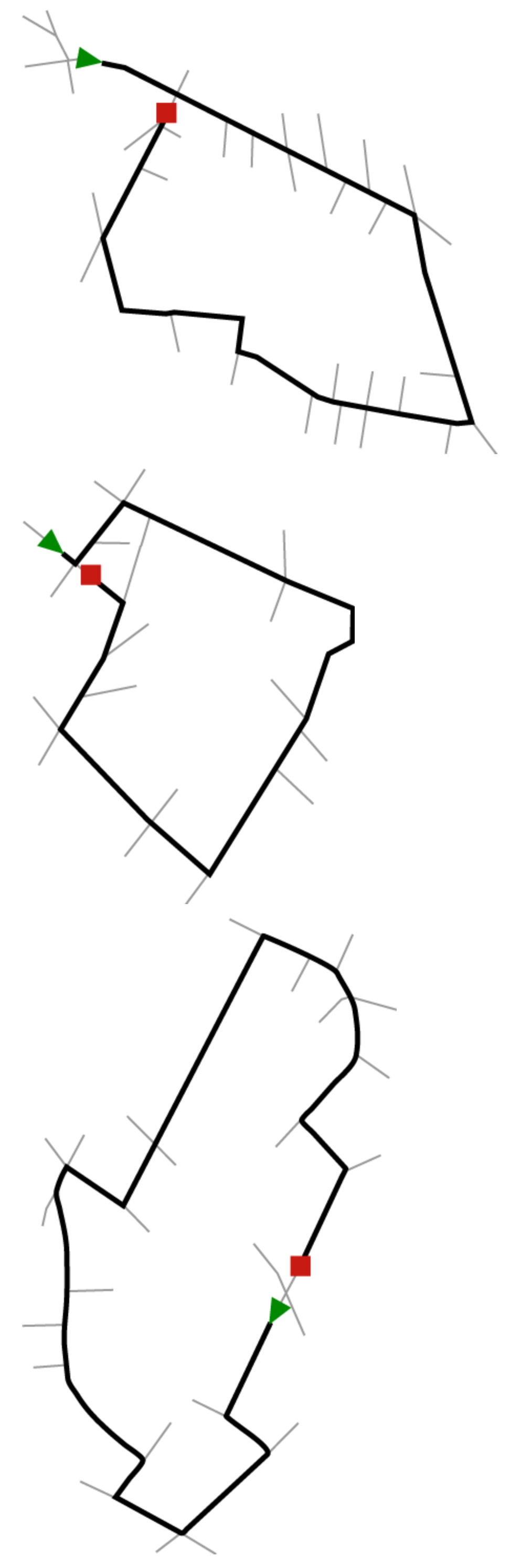
Some shortest routes by car in Boston #notanoptimalstreetlayout