Week 3: Linear programming
The week's question: What is he↑ up to?This week's material is built around answering a question about the handsome fellow above: When he gets back to browsing, will he be trying to eat as much as he can, or will he eat as quickly as he can to get on with other things? This is the question of optimal browsing. Animals have to eat some minimum amount to meet their metabolic requirements for survival, but what do they do once those have been met? Do they:
Linear programmingTo help us answer this question we will explore the tools of Linear Programming (LP, nothing to do with computer programming). These tools enable us to find maximum and minimum values, and to model optimization processes. This week we will learn the procedure for solving linear programming problems graphically. The process is straightforward, but looong (8 steps! 😬). At first it takes 20 to 30 minutes to do a single problem, and this week's entire exercise set is just two problems! (Next week we will see how to solve LP problems with more than two dimensions by pivoting matrices.) Exercises vs AssignmentsThe exercises are like physical exercises: prescribed actions to complete to develop a skill. 💪 They typically specify how to complete a problem, e.g. "Use a matrix to..." Assignments are different, with an "anything goes" ethos. In the first week we saw that there are multiple ways to solve any problem: visually by drawing, numerically by trial and error, exhaustive search, algebraically by symbol manipulation, and intuitively through insight. On assignments you are encouraged to use any and all techniques that move you towards a solution. Assignment questions are also integrative, they are based on the week's material, but often combine the techniques learned or extend them (and sometimes point out limitations in those techniques). 🤯
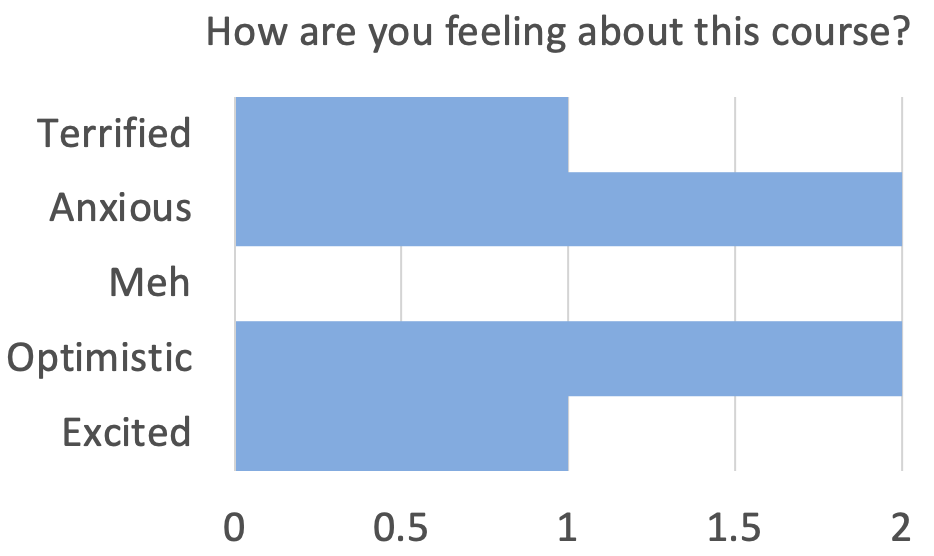
If that seems vague here are some implications for Assignment 2. Problem 1 does not require, or even benefit from, using a matrix. Two of the matrices in Problem 4 will have peculiar "solutions". And maybe the spreadsheet you created for Exercise 2.3 could be helpful on the assignment... Reminder: Exercise Set 2 is due by the start of class Monday!Be sure to hand me, or send me, your work. Don't let these easy marks slip through your fingers. Assignment 2 is due by 1 pm this FridayYou can hand me paper copies of your work or email me digital files. If you send me digital files, name them A2_firstname.suffix, e.g. I would use: A2_Tim.pdf A bit about youI appreciate the information you shared in the Exercise 1 survey. It's both helpful and interesting to know a bit about your backgrounds, and who you are. Here's how you (plural) are feeling going into the course:
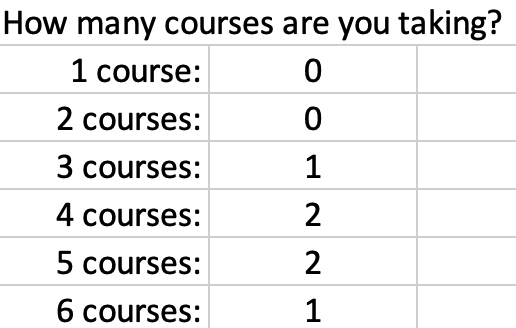
And here's how many courses you are taking:
So much for there being a typical student or course load! 😂 "Office" Hours: Get help, or just stick around to say "Hi"As a sessional instructor I don't have an office, but I am happy to stay after class and answer any questions you might have, provide just-in-time review, or just chat. That's all for now!See you soon,
|