Week 10
Modelling Uncertainty: Two helpers
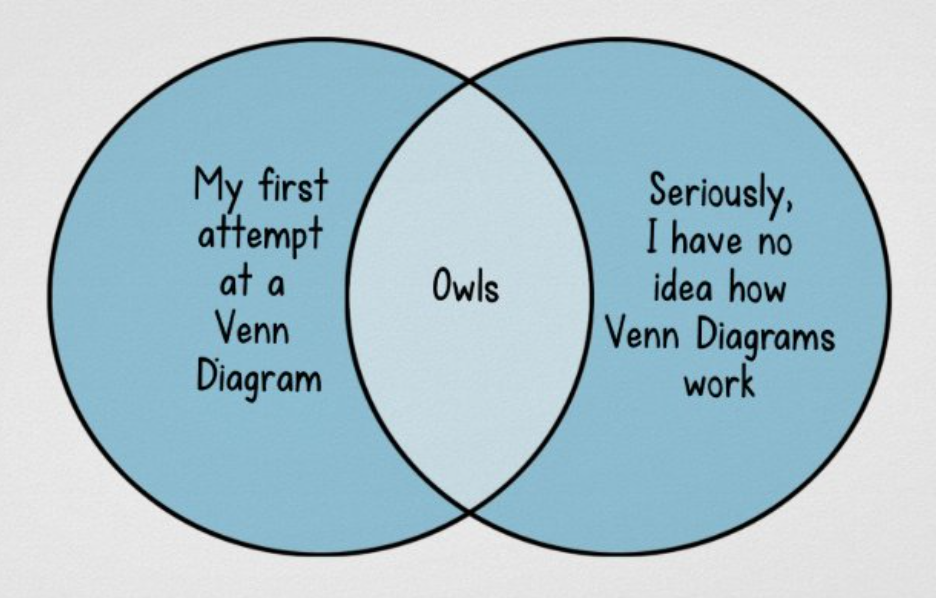
Making sense of numbers can be tricky and so can counting!
This week we'll look at a couple of helpers, techniques to help us organize collections of numbers (data), and to count possibilities.
We've seen many times that the hard part of using math on real world problems can be formulating the problem, not doing the "math". Converting real world descriptions in English or piles of numbers to mathematical representations like equations and diagrams can be the challenge. On Wednesday we'll look at using Venn diagrams to organize numbers especially when those numbers are obscured by paragraphs of text.
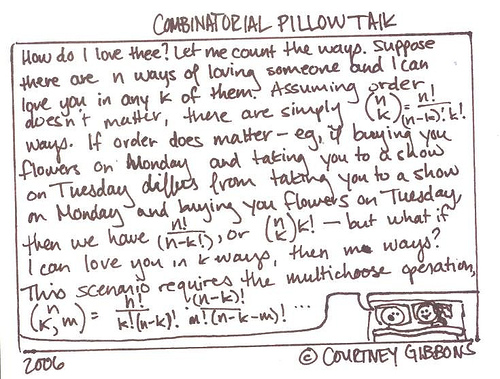
On Friday we'll get a little help with counting from combinatorics. Counting small amounts when we can enumerate all the items in front of us is easy. But counting possibilities when there are lots of them, e.g. how many Yukon license plates are possible, is trickier. To help us we'll look at the fundamental elements of combinatorics, one principle and two formulas: the Multiplication Principle, and formulas for Permutations & Combinations. If you have taken, or are in, an introductory stats course these may be familiar to you.
Reminder: Weird weeks mean unusual due dates 🕘
The short week before the reading break, and this one after it, have thrown off our regular submission schedule so this is your reminder that:
Bring-your-calculator-to-class weeks
We will be using our calculators a lot this week and next, focussing on some buttons that may be new to you, so don't forget to bring yours with you.
Will this work?
The next item was in a recent email, but surveys from previous years suggest there's only a 50% chance that you read the entirety of that email. By repeating it here do I guarantee that everyone will have read it, since 50% + 50% = 100%?
Advice: Before you begin an assignment or exercise
Pro tip
for doing exercise and assignment problems: Begin by preparing a one-page summary of the
week's material and keep it at your side.
Preparing the page is
an excellent way of warming up to do the problems, and then you'll have all the formulas and diagrams you need
handy. Even better, when the time comes to
create your cheat sheet for the final exam you can just make it up from your 13 weekly
formula pages. Some weeks I have provided a formula sheet that you can use as a starting
point (by printing it out and annotating it), but when I haven't, I strongly encourage you to create
one of your own. Cheatsheets rule! 😎
That's it for now!
See you in class,
Tim
|